
Data Case Studies
Cancer and rare disease researchers are increasingly looking to assemble data from multiple sources including routine NHS treatment data and to apply advanced analytics and risk modelling to identify novel prognostic approaches from large multi-modal datasets. Current exemplar data projects within the Cardiff Cancer Research Partnership include:
QuicDNA and the National Data Resource (NDR)
The Centre for Trials Research are partnering with Digital Health and Care Wales’ Advance Analytics team to pilot the use of their Secure Data Environment (the NDR) for research for service delivery evaluation.
Through accessing/utilising routine genomic data from the Welsh Clinical Portal to assemble control arm data for trials potentially, reducing research costs. This project has been designed to generate control arm data enabling the research team, in Cardiff University to perform service evaluation of the addition of liquid biopsy circulating tumour DNA testing in suspected lung cancer patients in research-ready hospitals, compared with standard care alone, plus more fully understand the utility of the NDR for research purposes.
The Wales Cancer Biobank Digital project
Wales Cancer Biobank (WCB) Digital project is a novel partnership of the All-Wales Medical Genomics Service (AWMGS) and the award-winning Wales Cancer Biobank (WCB).
WCB currently host 70k+ biosamples from patients with confirmed or suspected cancers in lung, breast, colorectal and prostate. Through the WCB’s broad consent and ethics model, the WCB Digital project allows linking of existing biobank samples, routine diagnostic results, treatment, outcome and histopathology data plus genomic data from the All Wales Medical Genomics Service, a novel data pipeline.
IPOCH (Interdisciplinary Precision Oncology Cardiff Hub)
Not all patients respond equally to the same treatments: there may be clues in a patient’s genome which can predict how they will respond to different treatments and are there common genomic signatures that will influence response to chemotherapy
Through using machine learning techniques, we are identifying disease fragmentation and patient response to specific drugs.
By looking for genetic explanations for differences in drug response common to different treatment pathways and developing models that use genomic data to predict drug response within standard treatment pathways, we are aiming to provide routes to tailor interventions for maximum impact. Working together with national data providers and clinical triallists, this work has a direct route for impact on routinely generated datasets.
WalesCAT
WalesCAT is an all-Wales extension to the previously successful CardiffCAT project: a database collecting de-identified information about cancer and the outcome of treatment a patient received. These projects will be used to help doctors better predict the outcomes of treatments for cancer, in incorporates both healthcare and radiological imaging data.
Through WalesCAT, the team from Velindre and Cardiff University, looks to advance the techniques in federated analytics, as developed in CardiffCAT to create Big Datasets which allow doctors to find new ways to predict how a tumour will behave and then test their results with other centres from around the world.
Cardiff ECMC
Cardiff ECMC uniquely unites translational research strengths in both solid tumours and haematological malignancies, bringing together our established track records in shared focus areas including novel trial design. Their ECMC-funded research nurses support Phase 1 trials in both haematological malignancies and solid tumours. They have an expanding early phase trial portfolio of both commercial and academically sponsored partnerships, leading national and international multi-centre studies and attracting investment.
Cardiff ECMC has close links with the Centre for Trials Research, Wales Cancer Research Centre, Wales Cancer Bank and the Cardiff University Medicines Discovery Unit. Cardiff ECMC supports a large cancer community within Wales, creating a vibrant translational environment of dedicated cancer researchers.
Finding and accessing patient-centred data
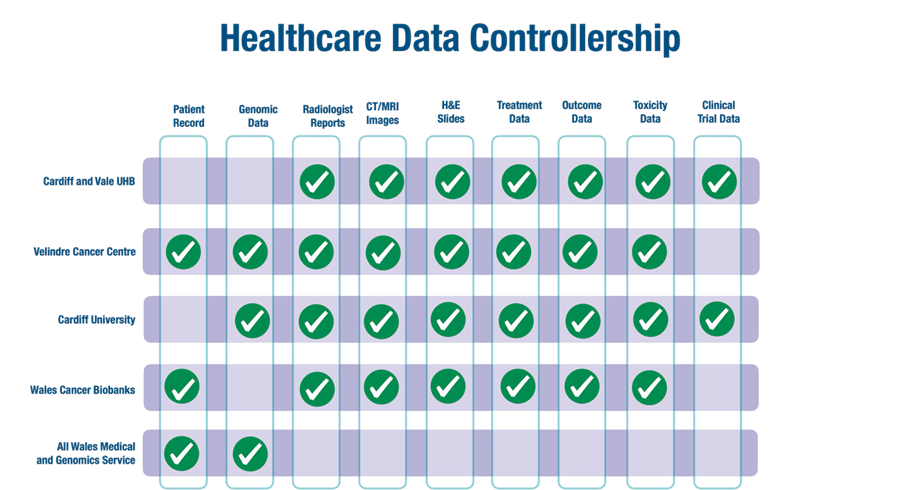
With the data for cancer patients held across multiple data controllers, the CCRP will provide the expertise and experience to researchers to understand the data assets available to them for research opportunities. The icon to the right provides a snapshot of the data assets available for cancer research, but with this picture continually evolving, our partners can advise on appropriate mechanisms for data curation.